
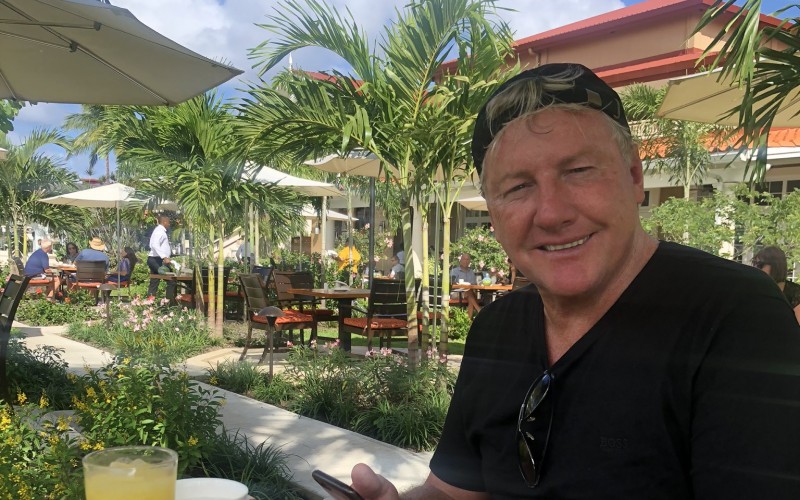
Frank McAvennie is a former Scottish professional footballer who became famous for his goals, colourful personality and successful spells with St Mirren, West Ham United and Celtic. Born Francis McAvennie in Glasgow on 22 November 1959, he played mainly as a striker and represented Scotland at the 1986 World Cup.
Known to fans as “Macca”, he built a reputation as a natural finisher with excellent movement inside the penalty area. His blonde hair, confident personality and exciting playing style also made him one of the most recognisable footballers of the 1980s.
Today, he works as an after-dinner speaker, football pundit, event guest and podcast presenter. He remains closely connected with Celtic, West Ham and Scottish football.
Frank McAvennie’s Early Life
Frank McAvennie grew up in Milton, Glasgow, and attended St Augustine’s School. Unlike many professional footballers, he did not enter a major youth academy at a young age. He began playing organised football seriously during his late teenage years.
Before becoming a professional, he played junior football for Johnstone Burgh. He also worked as a road sweeper and spent time considering a career in the Army. His journey showed that professional football was not always his planned career.
A trial with Partick Thistle became one of the most famous stories from his early life. He was introduced as a substitute and then taken off during the same match. The experience left him disappointed, but it did not end his ambition.
Joining St Mirren
St Mirren gave McAvennie the opportunity to play at professional level in 1980. He was about 20 years old when he joined the club, which was late compared with most modern footballers.
He initially played in midfield before moving into a more advanced role. His pace, strength and instinct for goal soon became clear. During five seasons at St Mirren, he made 135 league appearances and scored 48 goals.
His performances earned him the Scottish PFA Young Player of the Year award in 1981–82. By the middle of the decade, bigger clubs were watching him closely.
West Ham United and the Boys of 1986
Moving to England
West Ham United signed McAvennie from St Mirren in June 1985 for approximately £340,000. Manager John Lyall first viewed him as an attacking midfielder, but an injury to striker Paul Goddard changed his position. McAvennie moved into attack alongside Tony Cottee, and the partnership became one of the most effective in English football. He scored twice against Queens Park Rangers in only his second match for the club.
The 1985–86 season transformed his career. He scored 26 league goals and 28 goals in all competitions. Cottee also enjoyed a productive campaign, and the pair scored 46 league goals between them. West Ham finished third in the old First Division, their highest top-flight position at that time. They finished just four points behind champions Liverpool and became known as the “Boys of ’86”.
A Memorable Season
Frank McAvennie scored in West Ham’s famous 4–0 victory over Chelsea at Stamford Bridge. He also scored important goals against Tottenham Hotspur and other leading English clubs.
His goals attracted attention from television producers, and he appeared on BBC’s Wogan. The programme helped introduce him to a wider audience outside football. His success on the pitch quickly became linked with a glamorous London lifestyle.
The following season was less successful. West Ham finished 15th, while McAvennie scored seven league goals. In October 1987, he returned to Scotland to join Celtic.
Frank McAvennie Celtic and the 1988 Double
Joining His Boyhood Club
Celtic signed Frank McAvennie for approximately £750,000 on 2 October 1987. He had supported Celtic as a boy, so the transfer carried great personal meaning. Graeme Souness had previously tried to persuade him to join Rangers, but McAvennie rejected the move because of his loyalty to Celtic. His decision made him even more popular with Celtic supporters.
His start at Celtic was difficult. He became involved in a heated Old Firm incident with Rangers players Terry Butcher, Chris Woods and Graham Roberts. The clash became known as “Goldilocks and the Three Bears” because of McAvennie’s hairstyle and the three Rangers players involved.
Celtic’s Centenary Season
McAvennie soon found his best form. During the 1987–88 campaign, Celtic won the Scottish Premier Division and the Scottish Cup. His greatest Celtic moment came in the Scottish Cup final against Dundee United. Celtic fell behind, but McAvennie scored twice in the closing stages to secure a dramatic 2–1 victory.
He also scored twice against Rangers in a famous January 1988 match. His goals played a major part in Celtic’s first league and cup double in 11 years. Although he later returned to West Ham, his contribution to Celtic’s centenary season made him a lasting club favourite.
Returning to West Ham
Frank McAvennie returned to West Ham in March 1989 for approximately £1.25 million, becoming the club’s record signing at the time. His second spell was interrupted by a serious injury during the opening game of the 1989–90 season. A challenge by Chris Kamara caused severe damage to his leg and ankle, and he spent many months away from football.
He returned in March 1990 and helped West Ham win promotion during the 1990–91 season. He scored ten league goals and also helped the club reach the FA Cup semi-finals. The 1991–92 season was difficult for both player and club. West Ham finished bottom of the First Division and suffered relegation. McAvennie finished his final West Ham match in memorable fashion by scoring a hat-trick against Nottingham Forest after coming on as a substitute.
Scotland and the 1986 World Cup
Frank McAvennie won five senior caps for Scotland and scored one international goal.
The Australia Play-Off
His Scotland debut came against Australia in November 1985 during the World Cup qualifying play-off. Scotland won the first leg 2–0 at Hampden Park, with McAvennie scoring shortly after Davie Cooper. The second leg in Melbourne ended 0–0, sending Scotland through to the 1986 World Cup in Mexico.
Life in Mexico
Frank McAvennie played as a substitute against Denmark and West Germany. Scotland lost both matches before drawing with Uruguay and leaving the tournament at the group stage. In later years, he said he felt disappointed that he did not start in Mexico. He believed his partnership with Charlie Nicholas could have caused problems for opposing defences.
Later Clubs and Retirement
After leaving West Ham, Frank McAvennie joined Aston Villa but played only three league matches. He had short spells with Cliftonville in Northern Ireland and South China in Hong Kong. He then returned to Celtic for a second spell between 1992 and 1994. During the 1992–93 season, he scored nine league goals in 19 appearances.
His later career included a loan spell with Swindon Town, followed by Falkirk, where he scored twice in three matches. In October 1994, he returned to St Mirren for the final stage of his playing career. He retired in 1995 at the age of 35 after a professional career lasting approximately 15 years. His commonly recorded league total is more than 390 appearances and 136 goals.
Life Away from Football
Only an Excuse?
McAvennie’s lifestyle became the inspiration for a character played by Scottish comedian Jonathan Watson on Only an Excuse? The comedy programme presented an exaggerated version of the footballer as a confident womaniser with a strong Glaswegian personality. The phrase “Where’s the birds?” became closely associated with the character.
McAvennie has spoken about the joke with good humour. He has explained that the original phrase was closer to “Where’s the girls?”, but he accepted the version created by Watson.
His Autobiography
Frank McAvennie co-wrote Scoring: An Expert’s Guide, published in 2003. The book covers his football career, celebrity lifestyle, relationships, money problems, substance misuse and legal difficulties. During the years after football, he faced alcohol and cocaine problems, financial pressure and court cases. He later spoke openly about his mistakes and said he wanted people to remember his goals rather than only his troubles.
In 2000, he was cleared of involvement in a major drug conspiracy but admitted possessing cocaine. In 2009, he received a suspended sentence for affray after a fight outside a bar on the Isle of Man.
Frank McAvennie Wife, Partner and Family
Moya McVey is the woman most closely connected with Frank McAvennie in recent public coverage. His own website used the heading “Frank McAvennie’s Wife” for a page about her, while the text described her as his partner.
The couple were pictured together during a Valentine’s trip to Rome, and Moya was also present when McAvennie met Rod Stewart at the OVO Hydro in Glasgow. No confirmed wedding date has been made available. Therefore, it is safest to describe Moya as his publicly recognised partner and note that his website has referred to her as his wife.
McAvennie’s public Facebook material connects him with Glasgow and names Marie Hetherington as a sister. Older coverage also referred to a son. There is no dependable confirmation of a daughter or detailed current family record.
Frank McAvennie Current Work, Net Worth and Health
Frank McAvennie remains active as a football speaker and pundit. His podcast, Let Me Be Frank, is co-hosted with Simon Houston and discusses Celtic, West Ham, Scotland, current football and entertainment. He is also connected with Let Me Be Frank Podcast Ltd, an active company registered in Scotland. In 2025, the podcast supported Hamilton Academical Women’s team with sponsorship and a financial contribution.
There is no official figure for his net worth. Online estimates vary widely and have no confirmed financial basis. His own past interviews describe periods of financial difficulty, so celebrity websites should not be treated as reliable evidence.
No confirmed current illness has been established. His major known health event was the serious football injury suffered in 1989. He also received hospital treatment after a car crash in 2023 and later continued with his public work.
Frank McAvennie’s Lasting Legacy
Frank McAvennie remains remembered for three main achievements: his outstanding 1985–86 season with West Ham, his goals in Celtic’s 1988 centenary double and his role in helping Scotland qualify for the 1986 World Cup.
His colourful personality made him famous beyond football, while his honesty about personal problems gave his story another dimension. Today, he continues to entertain supporters through speaking events, television appearances and his podcast.
For Celtic fans, he is the striker who delivered two unforgettable Scottish Cup final goals. For West Ham supporters, he is one of the leading figures from the legendary Boys of ’86. For Scottish football, he remains one of its most distinctive and memorable characters.
Also Read
