
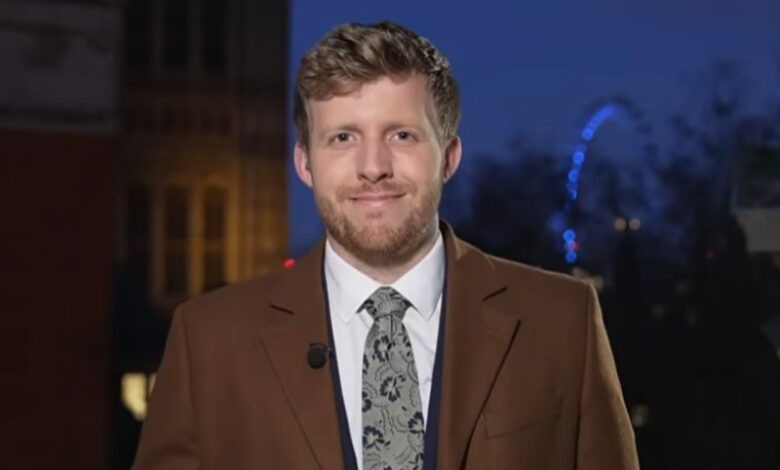
Fred Dimbleby is a British journalist who has developed a career across health, science, technology and politics. He is now a Political Correspondent for ITV News Calendar, where he covers government decisions, elections, regional issues and the people shaping public life in Yorkshire and Lincolnshire. His work has taken him from student journalism at Oxford to national newsrooms, Westminster and field reporting during major political campaigns.
Fred Dimbleby also belongs to a widely known British broadcasting family. His father, David Dimbleby, became a familiar BBC presenter, while his grandfather, Richard Dimbleby, was a pioneering war correspondent. The family connection has drawn interest, but he has built his own record through reporting, interviewing and political analysis.
Fred Dimbleby Age and Early Life
Contemporary coverage gives the journalist’s birth month as February 1998, making him 28 in August 2026. His exact day of birth has not been established through an official biography. Fred Dimbleby grew up in a family linked to journalism, broadcasting and television production. Politics, history and current affairs became central to his education and professional direction.
He attended Brighton College between 2009 and 2016. During his final school years, Fred Dimbleby gained top grades in Government and Politics, Religious Studies and History. His academic results helped him secure a place at the University of Oxford, where he chose to study History at Keble College.
Fred Dimbleby Parents and Education
Fred Dimbleby father is David Dimbleby, the former presenter of Question Time and a long-standing BBC election-night anchor. His mother, Belinda Giles, worked in television production before becoming a counselling psychologist and systemic psychotherapist. They have one son.
The wider family includes Richard Dimbleby, the BBC’s first major war correspondent, and broadcaster Jonathan Dimbleby. Fred also has three older half-siblings through his father’s first marriage: Liza, Henry and Kate. Henry later became known for work in food policy and for co-founding Leon, while Kate developed a career connected with music.
At Oxford, Fred studied History from 2016 to 2019. His degree supported his later work in politics. His student years also provided practical newsroom experience, which became more important than the family name in shaping his career.
Work at Cherwell
Fred Dimbleby joined Cherwell, Oxford’s independent student newspaper, first working as a comment editor. He later became deputy editor and then editor alongside Matthew Roller during Trinity Term in 2018. The newspaper’s records describe him as a second-year Historian at Keble and credit him with work across news, opinion, interviews and features.
His university journalism covered Oxford politics, student representation, higher education, university spending and controversial speakers. Fred Dimbleby also interviewed Michael Gove and Gary Lineker. The experience taught him to develop questions, check claims, meet deadlines and present complex subjects clearly.
Beginning a Journalism Career
His early experience extended beyond Oxford. In 2016, Fred Dimbleby chaired a Question Time-style debate at Brighton College and later made a radio appearance on BBC Sussex. This gave him practical experience in live broadcasting and political discussion.
In 2017, Fred Dimbleby worked as an intern reporter at the Brighton Argus. His work included stories about homelessness, Brexit’s effect on agricultural workers and a new supercomputer. He gained experience in local reporting, where national issues must connect to residents’ daily lives.
He also spent time at the BBC’s Nairobi bureau in 2018. During the placement, he examined business stories and assisted with field work for BBC World. This broadened his understanding of international journalism and reporting outside the United Kingdom.
Fred Dimbleby Career at ITV News
Fred Dimbleby joined ITV News as a journalism trainee in 2019. His early work focused on health and science, and he became involved in the newsroom’s coverage of the coronavirus pandemic. He helped arrange interviews, find case studies, produce material for reporters and write digital stories.
During the pandemic, his credited work included coverage of frontline doctors, protective equipment, testing, hospital pressure and a possible second wave. These stories required care because they involved medical evidence, government policy and people facing serious health risks.
His work also moved into technology and politics. He wrote and produced material about online campaigning, social-media platforms and the way digital communication was influencing elections. This combination of health, technology and politics gave him experience across subjects that affect both public policy and ordinary households.
Move Towards Political Journalism
In 2021, he spent time working in Westminster as a multimedia producer. The role placed him close to Parliament, political parties, advisers and campaign groups. It strengthened his ability to combine written reporting, video production and interviews.
He later worked with ITV News Channel, covering stories in the Channel Islands. His work included reports on assisted dying, regional economics, business issues and political decisions affecting island communities. These assignments gave him experience in explaining subjects that required sensitivity, legal awareness and attention to local voices.
During the 2024 general election campaign, he covered Reform UK and followed Nigel Farage’s political activity. His work examined the party’s campaign strategy, its support base and its relationship with wider debates about immigration, national identity and political dissatisfaction. He has continued to cover the party and other political groups in his present role.
Current Role at ITV News Calendar
ITV describes him as a Political Correspondent for ITV News Calendar. His work focuses on Yorkshire, Lincolnshire and other parts of northern England. He reports from Westminster, conferences, campaigns, constituencies and regional communities.
His recent subjects have included Northern Powerhouse Rail, regional mayors, local elections, the safety of MPs, business rates, social-media regulation, assisted dying, student finance and the political future of northern England. He also contributes to Last Orders, ITV Calendar’s political discussion programme, where politicians and commentators debate current affairs.
His coverage includes interviews with senior politicians, election analysis and reports from communities affected by government decisions. The work demands accuracy, speed and balance during contested political coverage.
Notable Professional Work
His professional record includes pandemic coverage, political interviews, reports from the 2024 election campaign and investigations into regional concerns. His work on threats faced by MPs examined the tension between public accessibility and personal security.
He has not been associated with a major individual broadcasting award in the reliable material available. His professional progress is instead shown through his movement from trainee roles to political correspondence and regular television reporting.
Important Connections and Significance
His family connection has influenced interest in his career, but it does not explain the full record of his work. He began with school broadcasting and Oxford journalism, gained experience in local newspapers and international broadcasting, then moved through trainee and production roles at ITV.
The family background gave him an unusual connection to British broadcasting history. His own career, however, has focused on modern journalism, digital media, health reporting, regional politics and television news. That combination gives him a professional identity distinct from the ceremonial and election coverage associated with his father and grandfather.
Conclusion
Fred Dimbleby is a British journalist whose career has developed through steady newsroom experience rather than celebrity exposure alone. His education at Brighton College and Oxford, leadership at Cherwell, early work with the BBC and Brighton Argus, and progression through ITV have created a broad foundation in modern reporting.
Today, he is best known for political correspondence at ITV News Calendar, especially his coverage of northern England, Westminster, elections and national policy. His engagement was publicly acknowledged in 2025, although his fiancée’s identity remains private. His work shows how a member of a famous broadcasting family can build an independent professional path through careful reporting, practical experience and a sustained interest in public life.
Also Read
